
Groundless Gaming Disorder, Korea Game User Association Files Public Petition to Ministry of Health and Welfare
근거 없는 게임중독, 게임이용자협회 복지부에 공개청원
2025.08.13 13:00 UTC+9
AI Summary
The Korea Game User Association is protesting the government's push to classify gaming as a disease. They claim the Ministry of Health and Welfare lacks a legal basis for this labelling. The association is now demanding transparency and legal accountability through petitions and administrative appeals.
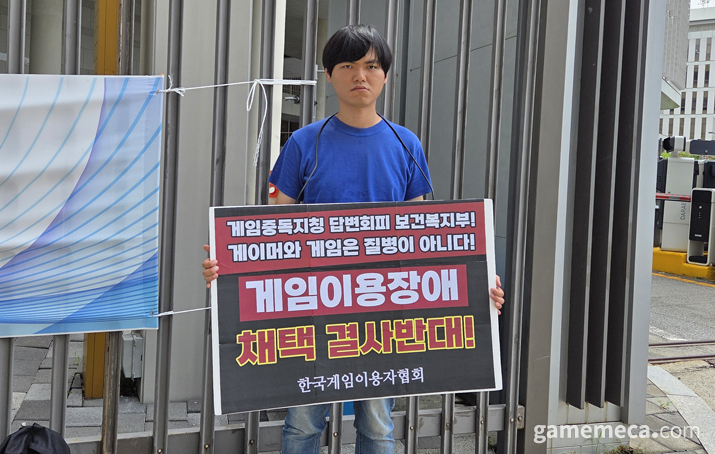
As the Office for Government Policy Coordination nears its final decision on adopting the WHO ICD-11 diagnostic code for gaming disorder, the Korea Game User Association (KGUA) has launched a series of relay protests, urging the public to join their open petition against the Ministry of Health and Welfare.
With the potential adoption of the code likely to be decided this October when the KCD-10 draft is unveiled, KGUA representatives—Director Noh Kyung-hoon, General Manager Choi Hyung-jong, and Deputy General Manager Kim Chul-min—staged a protest in front of the Government Complex Sejong, chanting, "Gaming is not a disease."
The participants condemned the Ministry’s policy, which they view as one-sided. They highlighted several core concerns: ▲the confusion between gaming habits and addiction ▲the failure to reflect the domestic reality of WHO recommendations ▲the potential for social stigma from mental health diagnoses ▲and the threat of industry contraction and job losses. The group expressed grave concern that the government is rushing the process without adequate public hearings or open debate.
The association emphasised that these demonstrations are entirely voluntary and demanded that the Ministry of Health and Welfare ensure procedural transparency and seek social consensus. They warned that implementing a disease code without sufficient scientific backing would not only stigmatise players but also deal a severe blow to the local gaming industry.
Meanwhile, the association is calling for gamers and industry professionals to join their open petition to the Ministry of Health and Welfare. This petition points out that institutions such as the Seongnam Addiction Management Integrated Support Center and the National Center for Mental Health have been treating online games as targets for addiction management simply because the Ministry of Health and Welfare included 'internet games' in their manuals without any clear legal basis.
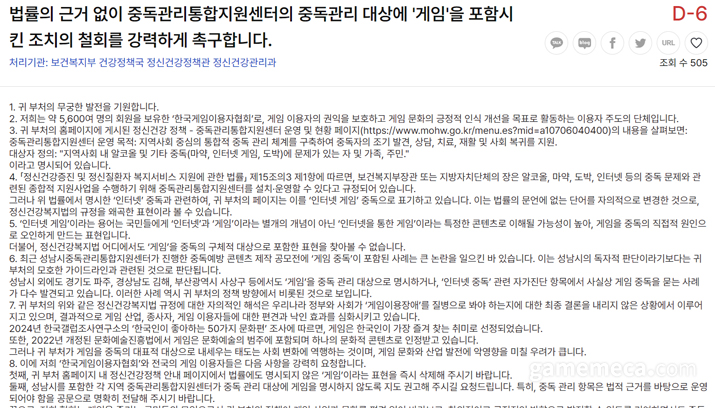
While the Mental Health Promotion and Welfare Act designates alcohol, narcotics, gambling, and the internet as subjects for addiction management, the Ministry has been arbitrarily interpreting the term 'internet' to include 'internet games' at its own discretion.
Simultaneously, the KGUA's legal policy division filed an information disclosure request regarding the members and discussion records of the public-private consultative body led by the Office for Government Policy Coordination. Upon the Office's refusal to disclose this information, the association filed an administrative appeal.
Lawyer Lee Chul-woo, the head of the association, remarked, "Gaming is a culture and an industry; a rushed adoption of a disease code will cause long-term damage to both users and the industry. The Ministry of Health and Welfare is deliberately labelling games as an addiction risk before a code is even adopted, while the Office for Government Policy Coordination has dragged out the consultative process for over six years, refusing to reveal any details under the guise of 'ongoing discussions'."
Lee added, "Given that the Democratic Party’s special committee on gaming suggested a moratorium on the disease code during the last presidential election, we expect a more forward-thinking decision from the current government."
The association plans to continue its relay protests at the Office for Government Policy Coordination, Statistics Korea, and the Ministry of Health and Welfare, alongside its members and the gaming community. They intend to exhaust every possible avenue, including petitions and administrative litigation, to fight this.
한국게임이용자협회(이하 협회)는 국무조정실의 게임 이용장애 질병코드(WHO ICD-11) 도입 검토가 막바지에 이른 가운데, 질병코드 등재 반대 릴레이 시위에 나서며, 보건복지부를 대상으로 한 공개 청원에 참여할 것을 촉구했다.
사실상 KCD-10 초안이 나오는 오는 10월에 게임 이용장애 질병코드 도입 여부가 결정되는 상황에서, 지난 8일 협회 질병화 관리 TF 소속 노경훈 이사, 최형종 본부장, 김철민 부본부장은 정부 세종청사 앞에서 '게임은 질병이 아니다'를 외치는 릴레이 시위를 했다.
참가자들은 피켓과 현수막을 들고 보건복지부의 정책 추진이 일방적이라 규탄했다. 특히 ▲게임 이용과 중독의 혼동 ▲WHO 권고의 국내 실정 미반영 ▲정신건강 진단에 따른 낙인 우려 ▲게임 산업 위축과 고용 감소 가능성 등을 지적했다. 정부가 충분한 공청회나 토론 없이 도입 절차를 서두르고 있다는 점에 강한 우려를 표했다.
협회는 해당 시위가 자발적으로 이어지고 있는 점을 피력하며, 절차적 투명성 확보와 사회적 합의 과정 마련을 보건복지부에 요구했다. 또한, 과학적 근거가 부족한 상태에서의 질병코드 도입은 게임 이용자에 대한 낙인뿐만 아니라, 국내 게임산업 전반에 심각한 위축을 초래할 수 있다고 경고했다.
한편 협회는 지난 6월 접수한 보건복지부 대상 청원이 공개 청원에 게임 이용자 및 업계인의 참여를 요청했다. 이 청원은 성남시 중독관리통합지원센터를 비롯한 전국 다수의 중독관리통합지원센터, 국립정신건강센터에서 인터넷 게임을 중독관리의 대상으로 단정하고 있는 근본적 원인이 보건복지부가 법적 근거 없이 홈페이지와 매뉴얼의 중독 관리 대상에 '인터넷 게임'을 포함시키고 있기 때문이라는 점을 꼬집었다.
실제로 정신건강증진 및 정신질환자 복지서비스 지원에 관한 법률(정신건강복지법)은 중독관리 대상으로 알코올, 마약, 도박, 인터넷을 중독관리통합지원센터 업무 범위로 규정하고 있다. 그러나 복지부는 자의적으로 '인터넷'을 '인터넷 게임'으로 명명하여 활용하고 있다.
동시에 협회는 법제정책본부를 통해 국무조정실 주도 민관협의체 운영에 대하여 구성원 명단과 지난 논의 내용에 대한 정보공개청구를 했으나, 국무조정실이 정보를 공개하지 않아 이에 대한 행정심판을 청구했다.
협회장인 이철우 변호사는 "게임은 문화이자 산업이며, 성급한 질병코드 도입은 이용자와 산업 모두에 장기적 손해를 끼칠 수 있다"라 지적하고, "보건복지부는 질병코드 도입 여부가 도입되지 않은 상태임에도 의도적으로 게임을 중독관리대상으로 치부하고 있으며, 국무조정실은 민관협의체 운영을 6년 넘게 끌어오고 있는데, 아직도 논의 중이라는 이유로 아무 정보도 밝히지 않고 있다"라고 밝혔다.
이어서 이 변호사는 "지난 대선 과정에서 민주당의 게임 특위가 게임 질병 코드 도입 유보를 제안한 사실도 있는 만큼, 정부의 전향적인 결정을 기대한다"라고 전했다.
협회는 향후에도 협회원들을 비롯한 게임 이용자와 함께 국무조정실, 통계청, 복지부를 대상으로 한 릴레이 시위를 이어갈 예정이다. 공개청원, 행정심판 이외에도 가능한 모든 수단을 강구할 계획이다.
This news was translated by AI.

Let's not lose our initial resolve. Meticulously, one by one. risell@gamemeca.com
READ MORE
-
 Greatsword-wielding dinosaur soulslike DinoBlade receives 'Very Positive' Steam rating
-
 Inspired by Silent Hill, New Korean Survival Game 'Nowhere Dawn' Revealed
-
 [gamescom 26] An RPG set in the US dominated by Japanese culture is coming
-
 Permanent Mercenary Usage, Path of Exile New League Starts on the 25th
RECOMMENDED NEWS
MOST POPULAR NEWS
- "I am back": Kylian Mbappé selected as cover model for EA Sports FC 27
- Palworld Officially Released, Transformed Into an Entirely New Game
- VCT Pacific Stage 2, Gen.G secures sole lead with two consecutive wins
- Simultaneous Launch of Skins and Apparel, PUBG Mobile Collaborates with Musinsa
- High-end Gaming PC Giveaway Event Hosted for Kakao PUBG
- Epic Games Store Summer Sale Begins with Discounts Up to 80%
- Webzen's 'Dragon Sword: Awakening' Injunction Dismissed, Steam Launch Confirmed
- KEL PUBG Mobile Finals to be Held in Daejeon on the 25th
- [LOL Meme] ShowMaker's Resurrection, Hungry Spirit Leads DK to EWC Victory
- Bethesda Announces Future Plans: The Elder Scrolls 6 and Fallout 5 Are Currently in Development
MEDIA PARTNERSHIPS


GAMEMECA SNS