
PD Kim Yong-ha: 'Anime-style games cannot be created with AI clicks'
김용하 PD "미소녀게임 'AI 딸깍'으로는 못 만든다"
2025.07.24 18:03 UTC+9
AI Summary
Executive Producer Kim Yong-ha argues that AI should support developers rather than replace them. Practical tests show that AI-generated assets and automation are still too unreliable for high-quality production. Success in the industry requires human creativity, with AI serving only as a tool for efficiency.
With the explosion of generative AI post-ChatGPT, the conversation surrounding machines replacing human roles has reached a fever pitch. Game developers are hardly exempt from this discourse. While unofficial, a report from the overseas media outlet Totally Human Media suggests that out of 114,000 games registered on Steam, approximately 7% (7,818 titles) have incorporated generative AI into their development, an eight-fold increase since April of last year. Meanwhile, reports of Microsoft downsizing its gaming divisions in favor of AI integration have only added fuel to the fire.
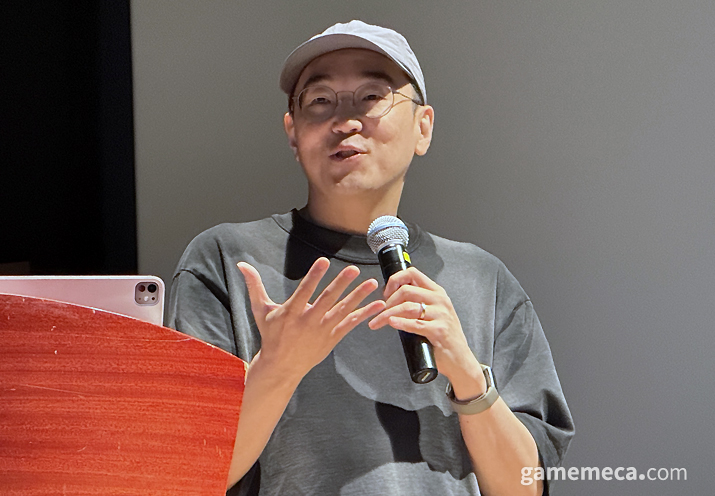
For industry professionals, navigating this AI landscape is no longer optional. Kim Yong-ha, the Executive Producer of Blue Archive who heads the IO division at NEXON Games, shared personal experiences on the subject at the 2025 Creative Talent Companion Project open lecture, held on the 24th at the Hanseong Baekje Museum. This event was hosted by the Korea Creative Content Agency and organized by Gem-Blo Company.
The lecture focused on 'Developing Anime-style Games in the AI Era.' Kim Yong-ha began with a blunt assessment: "Fans of character-driven games generally don't care for generative AI content. Personally, I find the idea of spending money on an image produced by a mere 'click' quite repulsive." Kim Yong-ha continued, "That is why I wanted to talk about how we should approach AI within this specific genre."
Beyond the aforementioned 'repulsion,' the current state of AI is simply not reliable enough for direct content production. Kim Yong-ha explained, "I thought it would be great if AI could handle level design, so I tasked it with creating a puzzle. I had it try Sokoban, a classic box-pushing game, and found that even the latest models struggle as soon as the difficulty spikes. If the AI can't solve the puzzles, creating them is a lost cause."
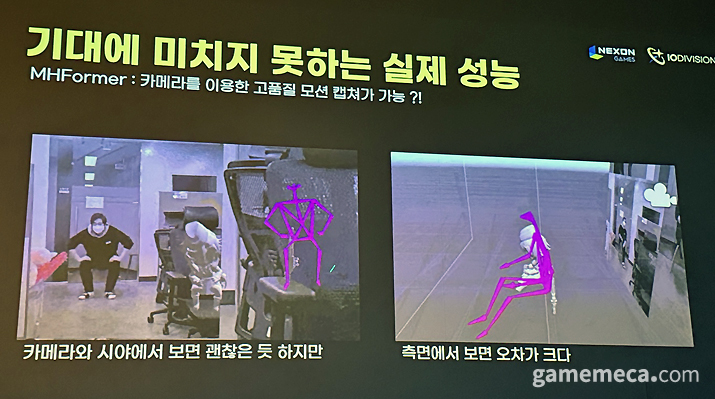
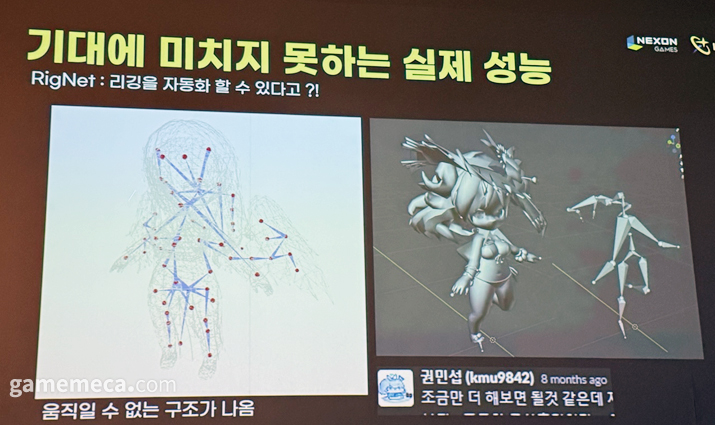
The limitations persist in motion capture and rigging—the process of setting up a 3D skeleton for character movement. "Rigging is a tedious, mandatory precursor to animation, and since papers claim AI handles this well, we tested it," noted Kim Yong-ha. "In practice, the AI attached bones in nonsensical ways that made the character physically impossible to move. We spent a month or two trying to make it work before eventually giving up."
Then there is the matter of cost. Kim Yong-ha pointed to the VR game 'Focus on You,' which was developed under Kim Yong-ha's direction. "We integrated an AI service for user voice recognition, but maintaining that service costs money. It was impossible to bake those recurring costs into the game's price. Because it's a packaged game, it meant paying every time a player used the feature, so we eventually removed the voice recognition functionality," Kim Yong-ha explained. Building a custom in-house solution is an alternative, but Kim Yong-ha emphasized that the development costs are far from trivial.
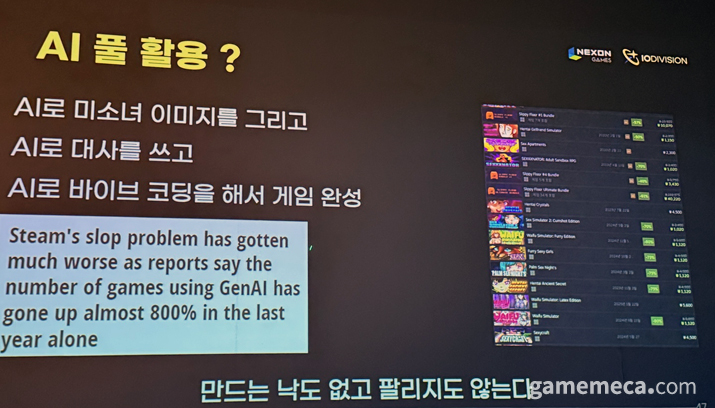
In short, generative AI has limited utility in game development, and the costs of building or subscribing to these services are prohibitive. Kim Yong-ha stated, "If you think AI development means just 'clicking' to generate images, dialogue, and code, you'll find plenty of such games on Steam. But they don't sell well, they get poor ratings, and they aren't fun to make. That methodology is fundamentally flawed."
Don't replace the developer; support them
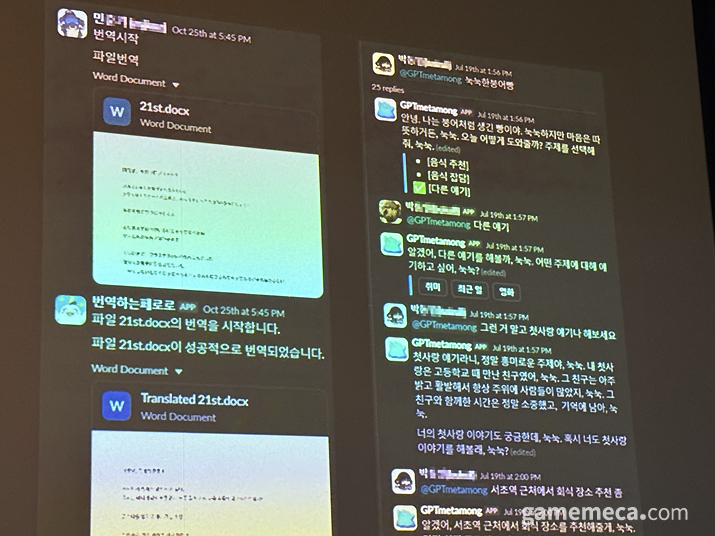
So, how does the Blue Archive team actually use AI? Primarily as a communication tool. The team uses an in-house chatbot to manage annual leave, organize meeting minutes, and handle translations. "We service the game in Japan and China," Kim Yong-ha mentioned. "We even have a feature that takes a comic strip and outputs a translated version, which significantly eases the communication burden and automates repetitive tasks for the staff."
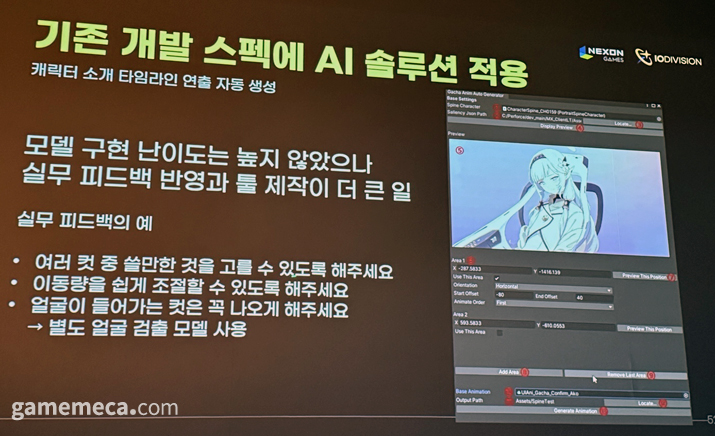
AI is also used in features that players directly experience, such as the presentation when unlocking a new character. Kim Yong-ha explained, "It involves close-ups of specific character parts—a repetitive task required every time we create a new character. We tested training an AI to automate this. It worked well enough to identify the key points of a character to highlight, turning a two-day task into a 30-minute job."
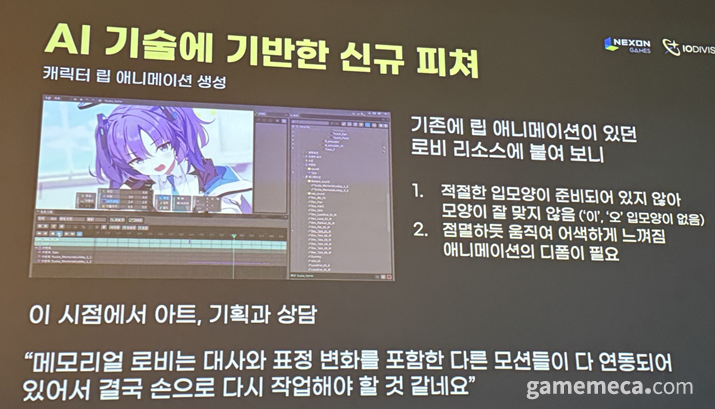
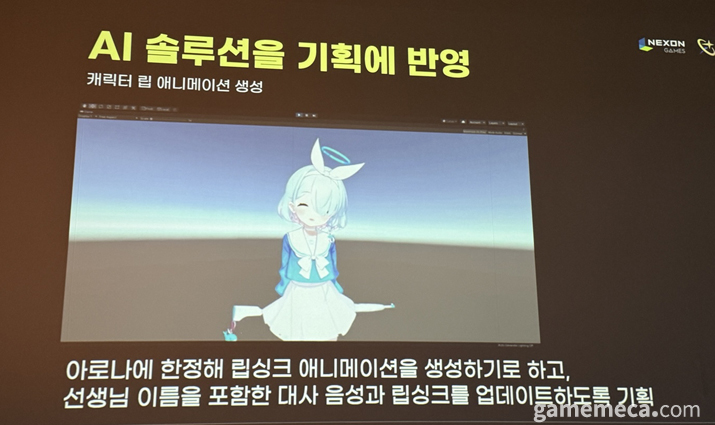
Beyond simple automation, the team is looking at how AI can offer players unique experiences. In Blue Archive, the character Arona calls out the player's ('Sensei's') name. Initially, the team explored automating lip-sync animation to match pre-recorded dialogue. However, they found that when the character's face is shown in close-up, the results were inconsistent and required too much manual correction. Kim Yong-ha noted, "Instead, we decided it worked best for specific moments, like when Arona calls the player's name."
Ultimately, the consensus from Kim Yong-ha is that replacing humans with AI is a dead end. "We should focus on how to increase the convenience for current developers," Kim Yong-ha argued. "Positions that provide dedicated support are crucial. I believe the roles of machine learning engineers and technical artists will become increasingly vital in game development."
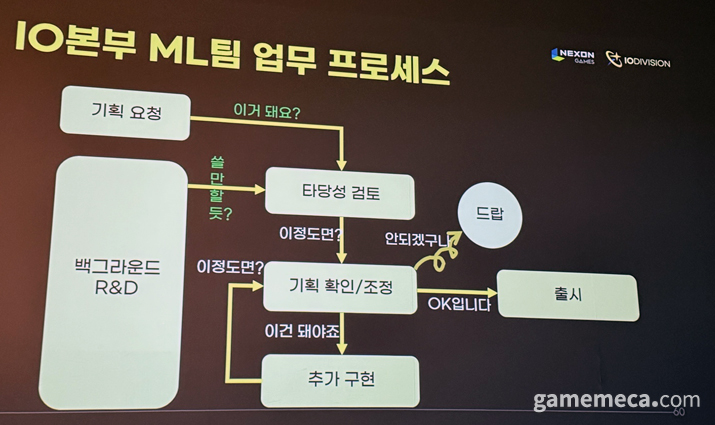
The NEXON Games IO division actually hosts a dedicated machine learning team. They research and develop AI tools requested by the planning team, verify feasibility, implement them, and iterate based on feedback. By building necessary datasets and automating repetitive workflows, they grant developers more room to focus on areas that truly require human creativity.
Finally, Kim Yong-ha shared thoughts on developing games entirely with AI. Regarding 'vibe coding' (creating results through prompts without writing code), Kim Yong-ha said, "It's very meaningful for prototyping. Things that used to take days can now be tested in minutes with good prompting. However, in a real production environment, AI output often conflicts with existing code or causes errors. You have to review everything with a fine-toothed comb. Implementing it wholesale in a codebase exceeding 10,000 lines is just not feasible."
On the topic of AI-driven free-flowing conversation between users and characters, Kim Yong-ha had reservations. "One thing to consider is that if a character answers any question, their characterization breaks. Within the lore, there are things characters shouldn't say. Answering everything indiscriminately ruins the persona. To maintain character integrity and gameplay, you need to impose constraints."
챗GPT를 기점으로 생성 AI가 급격히 발전하고 대중화되며 인간을 대체하는 영역에 대한 이야기도 활발히 나오고 있다. 게임 개발자 역시 예외는 아니다. 비공식 조사지만 AI 관련 해외 매체 ‘토탈리 휴먼 미디어(Totally Human Media)가 발표한 보고서에 따르면 스팀에 등록된 게임 11만 4,000개 중 약 7%인 7,818개가 개발 과정에 생성 AI를 활용했고, 그 수는 작년 4월보다 8배 늘었다. 아울러 MS에서 산하 게임사 인력을 감축하고, 이를 AI로 대체한다는 소식도 전해졌다.
이러한 AI 활용은 현업 개발자에게도 고민해볼 영역이 아닐 수 없다. 넥슨게임즈 IO 본부를 이끌고 있는 김용하 블루 아카이브 총괄 PD가 24일 한성백제박물관 한성백제홀에서 열린 2025 콘텐츠창의인재동반사업 오픈특강에서 이에 대한 본인 경험을 전했다. 이번 특강은 한국콘텐츠진흥원이 주최하고, 젬블로컴퍼니가 주관하는 창의인재동반사업 일환으로 마련됐다.
김용하 PD는 이 특강에서 ‘AI 시대의 미소녀 게임 개발’을 주제로 강연했다. 강연 서두에 그는 “캐릭터 게임을 좋아하는 유저 분들은 생성 AI 콘텐츠를 선호하지 않는다. ‘딸깍’으로 나온 그림에 비용을 지출한다는 것에 저 역시 굉장히 거부감이 있다”라며 “그렇기 때문에 이 장르에서 AI에 어떻게 접근해야 될까를 고민해본 것에 대해 말씀 드리려 한다”라고 말했다.
게임 개발에 AI를 사용하는 것은 앞서 이야기한 ‘거부감’ 외에도 현업에서 직접 콘텐츠를 뽑아낼 정도로 활용하기는 어려운 단계다. 김용하 PD는 “레벨 디자인을 AI가 해준다면 너무 좋겠다 싶어서 퍼즐을 만들어보는 것을 시키려 했다. 이에 박스를 옮겨 채워 넣는 소코반이라는 퍼즐 게임을 시켜봤는데 최신 모델도 난이도가 조금만 올라가도 어려움을 느낀다는 점을 확인했다. 퍼즐을 푸는 것을 못하면, 만드는 것은 더 어렵다”라고 설명했다.
이어서 모션캡처와 리깅(캐릭터 3D 모델이 움직이도록 뼈대를 넣는 작업)도 관련 논문을 보고 실제로 적용해봤을 때는 한계가 있었다. 김 PD는 “리깅은 애니메이션 전에 항상 해야 되는데 반복작업이라서 이걸 (AI가) 잘 할 수 있다는 논문이 있길래 해봤다”라며 “실제로 해보면 캐릭터가 움직일 수 없는 구조로 뼈를 이상하게 붙이는 것을 확인했다. 조금만 더 해보면 될 것 같아서 한두 달 정도 해보다가 포기했다”라고 말했다.
비용도 고려해야 한다. 김용하 PD는 과거 본인이 개발한 VR 게임 포커스 온 유를 예로 들었다. “포커스 온 유에 유저 음성 인식을 넣었는데, 이를 위해 AI 서비스를 도입했다. 이 서비스를 유지하는데 돈이 드는데 그 비용을 게임 가격에 포함시키기 어려웠다. 패키지 게임임에도 유저들이 플레이할 때마다 비용이 나가는 구조여서 현재는 음성 인식 기능이 빠진 상태다”라고 전했다. 외부로 비용이 나가지 않도록 자체적으로 만드는 방법도 있지만, 이 역시 비용이 만만치 않음을 강조했다.
요약하자면 생성 AI는 게임 개발 현업에는 매우 제한적으로 사용할 수 있고, 서비스를 사용하거나 구축하는 비용도 만만치 않다. 김 PD는 “AI를 활용해서 개발한다고 하면 AI로 이미지도 그리고, 대사도 쓰고, 코딩도 해서 ‘딸깍’하면 나온다고 생각할 수 있고, 실제로 그런 게임이 스팀에 많이 올라와 있다. 이렇게 만든 게임은 잘 팔리지도 않고, 평가도 좋지 않고, 만드는 사람도 재미 없다. 이러한 게임 개발 방법론은 아니라고 본다”라고 말했다.
AI로 개발자를 대체하지 말고, 그들을 도와라
그렇다면 블루 아카이브 개발팀은 어떻게 AI를 쓰고 있을까? 우선 커뮤니케이션 툴이 있다. 자체적으로 개발한 일종의 챗봇 형태로, 연차/반차 등 휴가 일정을 정리해주거나, 회의 내용을 문서로 정리해주거나, 번역을 해주는 등이다. 김용하 PD는 “저희는 일본이나 중국에도 서비스하고 있다. 현재는 만화를 넣으면 번역된 만화로 뽑아주는 기능도 있다”라며 “여러 명이 같이 일하며 생기는 커뮤니케이션 부담이나 반복작업을 덜어준다”라고 말했다.
유저들에게 실제로 보여주는 영역에도 AI를 기반으로 한 결과물이 있다. 대표적인 것이 캐릭터를 획득하면 볼 수 있는 등장 연출이다. 김 PD는 “캐릭터를 부분별로 클로즈업해주는 구성인데, 캐릭터를 만들 때마다 필요한 작업이고 어떻게 보면 반복작업이라 학습을 시켜서 자동화를 할 수 있지 않을까라고 생각해 테스트를 해봤다. 실제로 해보니 그럴 듯하게 캐릭터에서 주목할 부분을 뽑아서 연출을 만들어주는 툴로 작업할 수 있게 됐다. 이를 통해서 이틀 정도 걸리던 작업을 30분 만에 완료할 수 있다”라고 설명했다.
반복작업을 덜어내는 것이 아니라 유저들에게 AI로 색다른 경험을 제공해주는 부분도 고민했다. 현재 게임에 적용된 것은 블루 아카이브에서 아로나가 선생님(유저)의 이름을 불러주는 것이다. 본래는 음성으로 녹음된 대사에 맞춰서 캐릭터 입 모양을 만들어주는 ‘립싱크 애니메이션’을 자동화하는 방법을 고민하다가, 캐릭터 얼굴을 크게 보여주는 대목에서는 의도한 것처럼 결과가 나오지 않고 수정도 많이 해야 한다는 피드백이 돌아왔다. 김 PD는 “대신에 아로나가 선생님 이름을 불러주는 부분에서 입 모양을 맞춰주는 부분이라면 괜찮을 것 같다고 생각했다”라고 밝혔다.
정리하자면 AI로 사람을 대체한다는 생각은 현재로서는 답이 없다는 것이 그의 의견이다. 김용하 PD는 “현재 개발하시는 분들의 편의성을 어떻게 높여줄 수 있느냐의 관점에서 접근해야 한다. 이러한 작업을 할 때 중점적으로 서포트해주는 포지션이 굉장히 중요하다고 생각한다. 그러한 포지션으로서 앞으로 머신러닝 엔지니어나 테크니컬 아티스트의 역할이 게임 개발에서 중요해지리라 생각한다”라고 말했다.
실제로 넥슨게임즈 IO 본부에는 관련 업무를 전담하는 머신러닝 팀이 있다. 개발팀에서 필요할 만한 AI를 연구개발하거나, 기획 팀의 요청을 받아 타당성을 검토해보고, 실제로 구현해본 후 피드백을 반영해 쓸만하다고 판단하면 내부에서 툴로 활용하는 식이다. 개발조직에 필요한 데이터셋을 구축하고, 소통을 돕고, 반복업무와 공정을 자동화할 방법을 마련한다. 이러한 과정은 개발자들이 사람의 창의력이 필요한 영역에 좀 더 집중할 수 있는 여유를 준다.
마지막으로 AI만으로 게임을 개발하는 것에 대한 생각을 들어볼 수 있었다. 우선 바이브 코딩(코딩 없이 지시만으로 결과물이 나오도록 하는 것)으로 제작하는 것에 대해 김용하 PD는 “프로토타이핑(시제품을 만드는 것)으로는 굉장히 의미가 있다고 생각한다. 내가 생각했던 플레이나 시스템을 예전에는 며칠 걸릴 거 지금은 프롬포팅(AI에게 원하는 작업을 지시하는 설명문)을 잘하면 몇십 분 안에 테스트 해볼 수 있다”라며 “다만 현업에서는 나온 결과물이 기존 코드와 맞지 않거나 망쳐 버리는 경우가 실제로 있기 때문에 AI가 출력한 것을 세심하게 다시 봐야 한다. 1만 라인이 넘어가는 규모의 코드에서는 전격적으로 도입하기는 어렵다”라고 말했다.
이어서 AI로 유저와 캐릭터가 자유롭게 대화하는 것에 대한 견해를 밝혔다. 김 PD는 “한 가지 고민할 부분은 어떠한 질문에도 답을 하는 캐릭터라면 캐릭터성이 깨진다고 생각한다. 세계관 특성이나 캐릭터 성격상 말하지 말아야 하는 부분이 있고, 모든 질문에 답하는 것 자체가 캐릭터성을 망가뜨릴 수 있는 부분이라 생각하기 때문에, 어느 정도 제약을 둬야만 캐릭터성이 나오고 플레이도 만들 수 있다는 의견이다”라고 전했다.
This news was translated by AI.

Let's not lose our initial resolve. Meticulously, one by one. risell@gamemeca.com
READ MORE
-
 Greatsword-wielding dinosaur soulslike DinoBlade receives 'Very Positive' Steam rating
-
 Inspired by Silent Hill, New Korean Survival Game 'Nowhere Dawn' Revealed
-
 [gamescom 26] An RPG set in the US dominated by Japanese culture is coming
-
 Permanent Mercenary Usage, Path of Exile New League Starts on the 25th
RECOMMENDED NEWS

MOST POPULAR NEWS
- "I am back": Kylian Mbappé selected as cover model for EA Sports FC 27
- Palworld Officially Released, Transformed Into an Entirely New Game
- VCT Pacific Stage 2, Gen.G secures sole lead with two consecutive wins
- Simultaneous Launch of Skins and Apparel, PUBG Mobile Collaborates with Musinsa
- High-end Gaming PC Giveaway Event Hosted for Kakao PUBG
- Epic Games Store Summer Sale Begins with Discounts Up to 80%
- KEL PUBG Mobile Finals to be Held in Daejeon on the 25th
- [LOL Meme] ShowMaker's Resurrection, Hungry Spirit Leads DK to EWC Victory
- Bethesda Announces Future Plans: The Elder Scrolls 6 and Fallout 5 Are Currently in Development
- Webzen's 'Dragon Sword: Awakening' Injunction Dismissed, Steam Launch Confirmed
MEDIA PARTNERSHIPS


GAMEMECA SNS