
Unreal Engine 5-Powered 'Zeus: God of Omen' Reveals Detailed Visuals
언리얼5로 구현, 제우스: 오만의 신 상세 비주얼 공개
2026.05.27 14:27 UTC+9
AI Summary
Com2uS is publishing the blockbuster MMORPG 'Zeus: God of Omen,' developed by Aeverton, which is garnering anticipation for its high-quality graphics and world inspired by Greek mythology. The game is set in a world fractured by Zeus's hubris, where players become 'vessels of the gods' to prove their worth. Com2uS aims to launch 'Zeus: God of Omen' in the third quarter of this year, with plans to sequentially release information on its world, systems, and services.
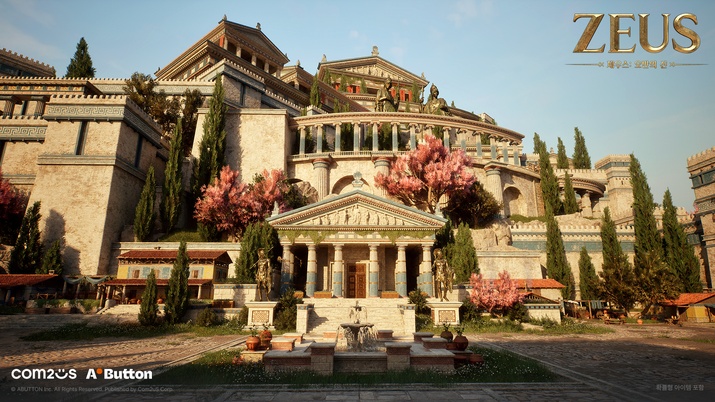
Com2uS announced on the 27th that it will release new visuals for 'Zeus: God of Hubris,' scheduled for a Q3 launch, and explained its graphic design direction. The game depicts a journey where players become a 'vessel of a god' to prove their worth in a world fractured by Zeus's arrogance.
The core of 'Zeus: God of Hubris' lies in its approach to the world-building, extending beyond mere narrative to encompass regional atmospheres, architectural styles, colour palettes of light, and topographical structures. Each area—from cities where divine authority still lingers, to lands ravaged by disaster, and spaces of sealing and punishment—conveys the world through distinct visual impressions.
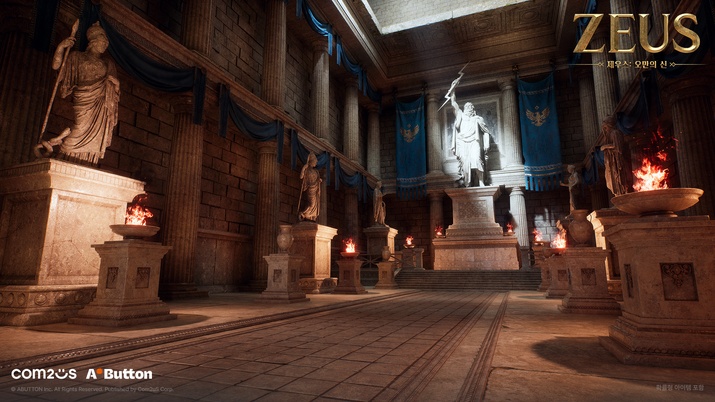
As a testament to this, the newly revealed Temple of Fate in Thebes, the southern region of the Nameless Forest, and the Temenos Garden and Thessalian Castle in Thessaly, all encapsulate the solemnity of temples, the vibrancy of gardens, and the majesty of fortresses and ruins within a single world. The grand topography and architecture leverage the direction of light, perspective, and material contrasts to enhance the depth and density of these spaces.
The cornerstone for achieving high-quality visuals is the latest graphics technology, primarily Unreal Engine 5. Lumen, a global illumination technology, realistically renders the real-time diffusion of light as it bounces off objects and spreads into surrounding areas, thereby reinforcing the atmosphere of each region. From torches illuminating the pillars and ceilings within the Temple of Fate, to the warm sunlight in the Temenos Garden, and the natural light reflecting off the stone and golden decorations of Thessalian Castle, the lighting alone intuitively conveys the emotion of each space.
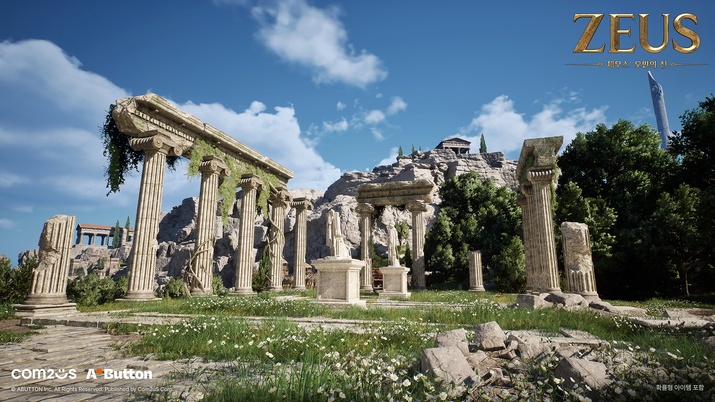
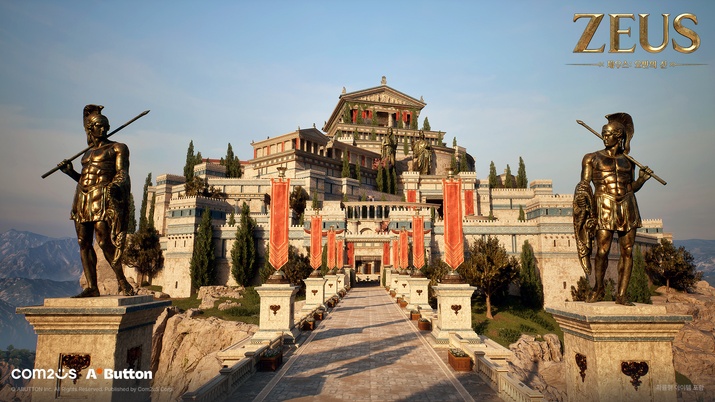
Material expression is also key to enhancing the realism of the spaces. Stone and metal decorations, vegetation, soil, and scorched rocks all exhibit different textures under the same light. Through physically based rendering, 'Zeus: God of Hubris' meticulously portrays the surface qualities of ancient Greek-style architecture, natural landscapes, and disaster-stricken areas, rendering the background as a space players can virtually inhabit. NVIDIA's latest DLSS technology is also a factor, balancing high-quality visuals with a stable gameplay environment.
Meanwhile, the development team is enhancing the game's quality by first implementing a high visual standard for PC and then optimising it for mobile environments. The plan is to balance visual density and operational stability through a process that addresses performance burdens during the engineering phase, followed by refining the art details.
컴투스는 27일, 3분기 출시 예정작 '제우스: 오만의 신'의 신규 비주얼을 공개하고 그래픽 디자인 방향성에 대해 설명했다. 본작은 제우스의 오만으로 균열이 발생한 세계를 배경으로, 유저가 '신의 그릇'이 되어 자신의 역할을 증명해 나가는 여정을 그린다.
제우스: 오만의 신은 세계관을 단순한 이야기 소재에 두지 않고, 지역의 분위기, 건축 양식, 빛의 색감, 지형 구조에까지 연결한 것이 핵심이다. 신들의 권위가 남아있는 도시, 재앙이 번진 대지, 봉인과 형벌의 공간 등 각 지역은 서로 다른 시각적 인상을 통해 세계관을 전달한다.
이를 보여주듯 새롭게 공개된 테베의 운명의 신전과 이름없는 숲 남쪽, 테살리아의 테메노스 정원과 테살리아 성은 신전의 장중함과 정원의 화사함, 성채와 유적의 위용을 하나의 세계 안에 담아냈다. 거대한 지형과 건축물은 빛의 방향과 원근, 재질의 대비를 활용해 공간의 깊이와 밀도를 살렸다.
고품질 비주얼 구현의 핵심 기반은 언리얼 엔진 5를 중심으로 한 최신 그래픽 기술이다. 글로벌 일루미네이션 기술인 루멘은 빛이 사물과 공간에 닿은 뒤 주변으로 번지는 효과를 실시간으로 자연스럽게 표현하며, 지역별 분위기를 강화한다. 운명의 신전 내부 기둥과 천장을 비추는 횃불, 테메노스 정원의 따사로운 햇살, 테살리아 성의 석재와 금빛 장식에 번지는 자연광은 조명 연출만으로도 각 공간의 정서를 직관적으로 전달한다.
공간의 현실감을 높이는 데에는 재질 표현도 핵심으로 두었다. 석재와 금속 장식, 초목, 흙, 그을린 암석은 같은 빛 아래에서도 각기 다른 질감을 드러냈다. '제우스: 오만의 신'은 물리 기반 렌더링을 통해 고대 그리스풍 건축물과 자연 지형, 재앙이 덮친 공간의 표면감을 세밀하게 표현하며, 배경을 유저가 직접 진입하는 공간처럼 구성한다. 엔비디아의 최신 기술인 DLSS도 고품질 비주얼과 안정적인 플레이 환경을 동시에 고려한 요소다.
한편, 개발진은 '제우스: 오만의 신'을 PC 기준의 높은 시각 품질로 먼저 구현한 뒤 모바일 환경 등에 맞춰 최적화하는 방식으로 완성도를 높여나가고 있다. 엔지니어링 단계에서 성능 부담을 정리하고, 이후 아트 디테일을 다듬는 공정을 통해 비주얼 밀도와 구동 안정성 사이의 균형을 맞출 전망이다.
This news was translated by AI.

I am dedicated to games and writing. viina@gamemeca.com
READ MORE
-
 Recruiting participants for the AI Game Sound Design Challenge in collaboration with GXG
-
 [Today's Steam] Conqueror’s Blade: Three Kingdoms, Overwhelmingly Negative
-
 Blade & Soul Revolution, Ranking Dungeon shifts from 2-player co-op to 1-player competition
-
 Competition to determine the strongest, [Stone Age Idle] Tribe War begins

MOST POPULAR NEWS
- [gamescom 26] An RPG set in the US dominated by Japanese culture is coming
- Webzen's 'Dragon Sword: Awakening' Injunction Dismissed, Steam Launch Confirmed
- "I am back": Kylian Mbappé selected as cover model for EA Sports FC 27
- Hyper Boost and Level Revamp, Black Desert Second Half Roadmap Revealed
- High-end Gaming PC Giveaway Event Hosted for Kakao PUBG
- KEL PUBG Mobile Finals to be Held in Daejeon on the 25th
- Mbappe and Bellingham on the Cover, 'EA Sports FC 27' Launches September 25
- The Seven Deadly Sins: Grand CROSS, TS characters of Meliodas and Ban arrive
- Blizzard Unveils BlizzCon 2026 Digital Collection Bundles
- Super Creative CEOs Kang Ki-hyun and Kim Hyung-suk to Depart from the Company
MEDIA PARTNERSHIPS



GAMEMECA SNS